
35-day Grand world Voyage
35-night Grand Voyage from Ft. Lauderdale, Florida to Sydney, Australia aboard Volendam.
Calling at Manta, Lima, Easter Island, Pitcairn Island, Tahiti, Bahia d Opunoha, Bora Bora, Apia, Savusavu, Suva, Lifou, Noumea and Sydney, with 18 days at sea. 14 ports of call across Florida, Ecuador, Peru, Chile, Pitcairn Islands, French Polynesia, Western Samoa, Fiji, New Caledonia and Australia.
Volendam is a Holland America Line ship that entered service in 1999, carrying around 1,430 guests. One of the smaller ships in the fleet, she is prized for longer and more unusual itineraries, with a flower-themed art collection and the line’s classic teak promenade deck.
Stateroom categories range from Interior to Ocean View.
- 05 Jan 2027 – 09 Feb 2027
from $12,599 pp twin share *
Additional Pricing Information
- Interior from $12,599 pp twin share
- Ocean View from $13,599 pp twin share
* Prices and category availability are subject to change without notice.
Itinerary
Day 1 – Ft. Lauderdale, Florida
Departs 07:00 pm.
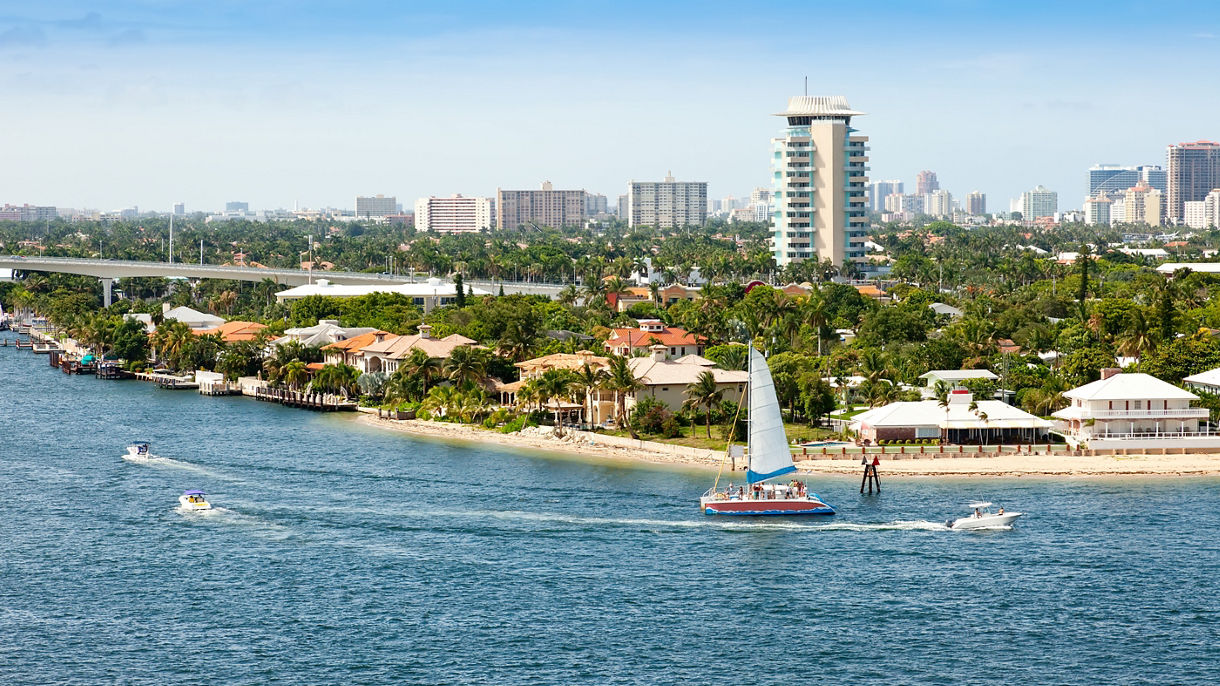
According to the popular 1960 beach movie, Fort Lauderdale is “where the boys are.” The city’s reputation as America’s Spring Break capital, however, has been replaced with the more favorable image of a prime family tourist destination, attracting more than 10 million visitors annually. The most popular beach resort in Florida is even more rightly famed as the “Yachting Capital of the World,” with more than 40,000 registered crafts calling its waters home. The city also prides itself on being the “Venice of America” with more than 300 miles of navigable waterways. Fort Lauderdale boasts world-class theaters, museums, sightseeing, and shopping. The city sits 24 miles north of Miami and is named after a series of forts built by the United States during the second Seminole War. The forts took their name from Major William Lauderdale, who was the commander of the detachment of soldiers who built the first fort. Look hard and you might find remnants of three of them today. More people seem to be interested in taking a water tour aboard the “Carrie B.”
Day 2 – At Sea
Day 3 – At Sea
Day 4 – At Sea
Day 5 – Enter Panama Canal Cristobal
Arrives 06:00 am, departs 06:00 am.
Day 5 – Cruising Panama Canal
Day 5 – Exit Panama Canal Balboa
Arrives 06:00 pm, departs 06:00 pm.
Day 6 – Crossing the Equator
Day 7 – Manta, Ecuador
Arrives 05:00 am, departs 04:00 pm.
The breezy, seaside city of Manta is the second largest port in Ecuador and possesses one of the world’s most varied terrains. To the west of Manta lie the Galapagos Islands. To the east rises the great rampart of the Andes. The Mantas were known for their traditional balsa rafts in the coastal waters and their ceramics and pottery. A huge tuna statue greets you on its shores, a whimsical nod to the tuna capital of the world. Fresh seafood is always on the menu, and a stroll along the promenade lets you take in the beach scene. The bustling center of town, an easy walk from port, displays a lively marketplace selling Panama hats, silver jewelry and apparel. There is lush green parkland; the nearby colonial town of Montecristi, the center of the Panama hat industry; and the Pacoche Wildlife Refuge, home to indigenous flora and fauna and cheeky howler monkeys. Explore the rich culture, heritage and people of Manta during scenic adventures that take in the Archaeological Museum, which highlights a small, well-curated collection of ceramics of the Manteño-Huancavilca culture that flourished here between 800 and 1550 A.D. Whether you explore its past or its vibrant city of today, a day in Manta is a rich and colorful experience.Note: Manta offers little in the way of tourist infrastructure. Transportation and tour guides are imported to the area. Despite the sometimes hot and humid conditions there is no guarantee of air-conditioned vehicles.
Day 8 – At Sea
Day 9 – Lima (callao), Peru
Arrives 10:00 am.
In 1535, Francisco Pizarro labeled the open plains where Lima now stands as inhospitable. Despite the verdict of the great conquistador, Lima became the center of imperial Spanish power, a “City of Kings” where 40 viceroys would rule as the direct representatives of the King of Spain. With independence in 1821, Lima became Peru’s capital. Near Lima, one of the world’s most desolate deserts is home to the famed drawings of Nazca. These drawings inspired Erik von Daniken’s best-selling book “Chariots of the Gods.” With mysteries seeming to be part of Peru’s history, perhaps these “drawings” are in fact “the largest astronomy book in the world.”
Day 10 – Lima (callao), Peru
Departs 06:00 pm.
In 1535, Francisco Pizarro labeled the open plains where Lima now stands as inhospitable. Despite the verdict of the great conquistador, Lima became the center of imperial Spanish power, a “City of Kings” where 40 viceroys would rule as the direct representatives of the King of Spain. With independence in 1821, Lima became Peru’s capital. Near Lima, one of the world’s most desolate deserts is home to the famed drawings of Nazca. These drawings inspired Erik von Daniken’s best-selling book “Chariots of the Gods.” With mysteries seeming to be part of Peru’s history, perhaps these “drawings” are in fact “the largest astronomy book in the world.”
Day 11 – At Sea
Day 12 – At Sea
Day 13 – At Sea
Day 14 – At Sea
Day 15 – At Sea
Day 16 – Easter Island, Chile
Arrives 08:00 am, departs 05:00 pm.
The monoliths of Easter Island have fascinated and puzzled Westerners since the Dutch seaman Roggeven made landfall there on Easter Sunday, 1722. The mystery of Easter Island’s first settlers remains just that – a mystery. Today, most anthropologists believe the island was settled as part of the great wave of Polynesian emigration. (The oldest of the Moai, as the great monoliths are called, date to 700 A.D.) The society that produced the Moai flourished during the 16th and 17th centuries, but population growth, deforestation and food shortages led to its collapse. Today some 3,400 souls inhabit this 64-square-mile island, which lies some 2,200 miles equidistant from Tahiti and South America.The society of Rapa Nui possessed stone-working skills on a par with those found in the Inca Empire. Islanders also possessed a script called Rongorongo, the only written language in all of Oceania.Please note: The current fee for entry into the National Park is $80 per person, this fee is included in all organized shore tours. Independent passengers are required to pay this fee on arrival at the park.Easter Island is an anchorage port. Transportation from the ship to shore will be via the ship’s tender service.
Day 17 – At Sea
Day 18 – At Sea
Day 19 – Pitcairn Island (scenic Cruising), Pitcairn Islands
Arrives 08:00 am, departs 12:00 pm.
Lying below the tropic of Capricorn, halfway between New Zealand and the Americas, lonely Pitcairn Island is one of the most remote inhabited islands in the world. It was here that Fletcher Christian and eight of the mutineers of the HMS Bounty, along with their Tahitian companions, came in search of a new life. Set aflame and sunk by the infamous mutineers, parts of the legendary HMS Bounty shipwreck are still visible in the waters of Bounty Bay.Today, one of the island’s most famous residents is its sole surviving Galapagos Giant Tortoise, named Turpen, who was introduced to Pitcairn sometime between 1937 and 1951. Several species of seabirds also nest here, including the flightless Henderson Crake, Fairy Terns, the Common Noddy, the Red-tailed Tropic Bird and the Pitcairn Island Warbler.Note: Pitcairn is a scenic cruising site. Ships will slowly travel past while a knowledgeable port lecturer points out significant sites you’ll be able to see onboard.
Day 20 – At Sea
Day 21 – At Sea
Day 22 – Tahiti (Papeete), French Polynesia
Arrives 08:00 am.
Papeete, the beating heart of French Polynesia, dances to the rhythm of island life while embracing modernity. Set against the backdrop of Tahiti’s emerald mountains and azure waters, this bustling capital city captivates with its fusion of French flair and Polynesian culture.Stroll through its vibrant markets, where the scent of exotic fruits mingles with the melodies of local musicians. Explore the historic sites, like the iconic Notre Dame Cathedral and the regal Presidential Palace, which reflect the city’s colonial past.Papeete’s waterfront promenade beckons with its bustling marina, offering glimpses of luxurious yachts and traditional outrigger canoes bobbing in the harbor. Indulge in delectable French-Polynesian cuisine at waterfront cafes and fine dining establishments, where fresh seafood delights the palate.Yet amid the urban buzz, Papeete maintains its connection to nature, with lush parks and gardens providing tranquil retreats. Whether you’re soaking up the sun on black sand beaches or immersing yourself in the vibrant local arts scene, Papeete invites you to experience the enchantment of the South Pacific with a touch of French sophistication.
Day 23 – Tahiti (Papeete), French Polynesia
Departs 05:00 am.
Papeete, the beating heart of French Polynesia, dances to the rhythm of island life while embracing modernity. Set against the backdrop of Tahiti’s emerald mountains and azure waters, this bustling capital city captivates with its fusion of French flair and Polynesian culture.Stroll through its vibrant markets, where the scent of exotic fruits mingles with the melodies of local musicians. Explore the historic sites, like the iconic Notre Dame Cathedral and the regal Presidential Palace, which reflect the city’s colonial past.Papeete’s waterfront promenade beckons with its bustling marina, offering glimpses of luxurious yachts and traditional outrigger canoes bobbing in the harbor. Indulge in delectable French-Polynesian cuisine at waterfront cafes and fine dining establishments, where fresh seafood delights the palate.Yet amid the urban buzz, Papeete maintains its connection to nature, with lush parks and gardens providing tranquil retreats. Whether you’re soaking up the sun on black sand beaches or immersing yourself in the vibrant local arts scene, Papeete invites you to experience the enchantment of the South Pacific with a touch of French sophistication.
Day 23 – Bahia d Opunoha, Moorea, French Polynesia
Arrives 08:00 am, departs 06:00 pm.
Day 24 – Bora Bora, French Polynesia
Arrives 07:00 am, departs 05:00 pm.
Day 25 – At Sea
Day 26 – Cross International Date Line
The International Date Line is an imaginary line extending from the North Pole to the South Pole through the Pacific Ocean. It serves as the 180th meridian of longitude, and is used to designate the beginning of each calendar day.As you know, each adjacent time zone on the map has an hour time difference. However, at the International Date Line, +12 hours and -12 hours meet, bringing about a 24-hour time change. When your ship crosses to the west it’s one day later; if your ship crosses to the east, you’ve gone back a day.Crossing the International Date Line has long been a rite of passage for sailors, who often must participate in a line-crossing ceremony to become part of the sacred “Order of the Golden Dragon”, an honorary naval fraternity.
Day 27 – Apia, Western Samoa
Arrives 10:00 am, departs 06:00 pm.
The first Polynesians arrived in Western Samoa around 1000 B.C. Three millennia later, the islands formed one of the last bastions of traditional Polynesian culture. Apia, the capital of Western or Independent Samoa, is a city of 40,000 on the island of Upolu. Its picturesque waterfront is lined with public buildings, shops and trading companies. The town now comprises of modern 3-5 story buildings all along the waterfront. Government has built some very modern buildings to house most of the government offices. The village settings can only be seen in the outskirts of town within a radius of 15 miles. Western Samoa has long lured Westerners to its islands. The most famous expatriate of all was Robert Louis Stevenson, who lived at Vailima, and was buried near the summit of Mt. Vaea.Dress in light, comfortable clothing when visiting Apia. The dress code is quite casual. Shorts are appropriate for men. Dress for women is more conservative. The local women wear long skirts, dresses, lava lavas or muumuus.
Day 28 – At Sea
Day 29 – Savusavu, Vanua Levi, Fiji
Arrives 08:00 am, departs 05:00 pm.
Day 30 – Suva, Fiji
Arrives 08:00 am, departs 05:00 pm.
The Fiji archipelago is at the cross roads of the South Pacific. In the days of sailing ships, it was known as “The Cannibal Isles,” where mariners carefully avoided its fierce warriors and perfidious waters. Thankfully, Fiji’s pagan days live only in the tales recalled by tour guides – in rituals such as fire-walking, Kava Ceremonies and in renditions of tribal drumming, dance and song. Fiji is an exotic destination, with 333 islands that provide an exciting adventure or peaceful repose. The northwest region, where the sun shines almost every day and a tropical shower ends as quickly as it began, is home to the majority of the resorts. Suva, the political, administrative, educational and commercial center, has a backdrop of lush rainforest maintained by the inevitable “tropical downpour.” The people of Fiji are the most multiracial and multicultural of all South Pacific island countries – this being reflected in churches of all denominations, mosques, temples and shrines. Built around a reef-protected natural harbor, Suva, with its colonial buildings nestled alongside modern commercial venues, shops and local markets, parks and residential sprawl, is home to nearly half of Fiji’s urban population.
Day 31 – At Sea
Day 32 – Lifou, New Caledonia
Arrives 09:00 am, departs 05:00 pm.
The largest of the Loyalty Islands, Lifou lies some 118 miles to the northwest of New Caledonia. The island is an ancient makatea – a fossilized coral atoll raised high above sea level. Whalers were the first Westerners to visit this Melanesian paradise – though greedy traders lured by the island’s aromatic sandalwood trees soon followed. Today’s visitors are drawn attracted to the island’s spectacular scenery, which ranges from dense tropical forest to dramatic cliffs towering above the crashing waves. Lifou’s white-sand beaches are some of the finest to be found in the entire Pacific.Lifou and the other Loyalty Islands are part of New Caledonia, which, like Tahiti, is an overseas province of France. The island is a center of traditional Melanesian culture. Easo is an anchorage port. Guests transfer to shore via ship’s tender.
Day 33 – Noumea, New Caledonia
Arrives 07:00 am, departs 03:00 pm.
The capital of New Caledonia, Noumea is a little piece of France in the middle of the Pacific Ocean. Before World War II, New Caledonia was a little known and seldom-visited French possession known for its penal colony and its natural resources. (Nickel smelting still plays a major role in the island economy.) Today, travelers are drawn to New Caledonia for its scenic beauty. The island is famed for its white-sand beaches while its barrier reef is the world’s second longest. The offshore waters also offer superb diving and snorkeling.In 1774, James Cook thought the island’s rugged hills resembled those of his native Scotland. Hence he christened the island New Caledonia. The island and its outlying groups became a French colony in 1854 and an overseas department of France in 1956.
Day 34 – At Sea
Day 35 – At Sea
Day 36 – Sydney, Australia
Arrives 06:30 am.
As your ship passes Harbour Heads, you are presented with the shimmering skyline of Sydney – hailed by many seafarers as “the most beautiful harbor in the world.” Two prominent landmarks, Harbour Bridge and the sail-like curves of the Sydney Opera House, grace the backdrop of this picturesque harbor. There is a wealth of adventure waiting in Sydney – from its cosmopolitan city center to miles of beautiful beaches and the Blue Mountains.Australia’s oldest and largest city was born in 1788 with the arrival of the “First Fleet” transporting 760 British convicts. Today, Sydney is the largest port in the South Pacific and is often voted the most popular destination in the South Pacific.
Highlights
- Main Dining Room and casual venues included in your fare
- Fitness centre, swimming pools and nightly live entertainment onboard
- Enrichment programme and port talks to prepare you for each destination
35-night Grand Voyage from Ft. Lauderdale, Florida to Sydney, Australia aboard Volendam.
Calling at Manta, Lima, Easter Island, Pitcairn Island, Tahiti, Bahia d Opunoha, Bora Bora, Apia, Savusavu, Suva, Lifou, Noumea and Sydney, with 18 days at sea. 14 ports of call across Florida, Ecuador, Peru, Chile, Pitcairn Islands, French Polynesia, Western Samoa, Fiji, New Caledonia and Australia.
Volendam is a Holland America Line ship that entered service in 1999, carrying around 1,430 guests. One of the smaller ships in the fleet, she is prized for longer and more unusual itineraries, with a flower-themed art collection and the line’s classic teak promenade deck.
Stateroom categories range from Interior to Ocean View.
Inclusions
- Dining in the main Dining Room and casual venues
- Live music venues and nightly entertainment
- Fitness centre and swimming pools
- Enrichment programme and port talks
FAQs
Volendam is a Holland America Line ship that entered service in 1999, carrying around 1,430 guests. One of the smaller ships in the fleet, she is prized for longer and more unusual itineraries, with a flower-themed art collection and the line’s classic teak promenade deck.
Stateroom categories available on this sailing: Ocean View and Interior.
How long is this journey?
This itinerary runs for 36 days and 35 nights.
When can I travel?
Departures are currently scheduled between 05 Jan 2027 and 10 Feb 2027, subject to live availability.
What is generally included?
Inclusions typically cover guided touring and selected experiences, with exact details listed in the itinerary.
What style of accommodation is used?
Accommodation is pre-arranged as part of the journey, with specific properties shown in the trip details.
Provided by: Holland America LineFine Print
Terms and conditions apply. Click here for more details.
Enquire Now
Speak with our travel experts and get your personalised quote.